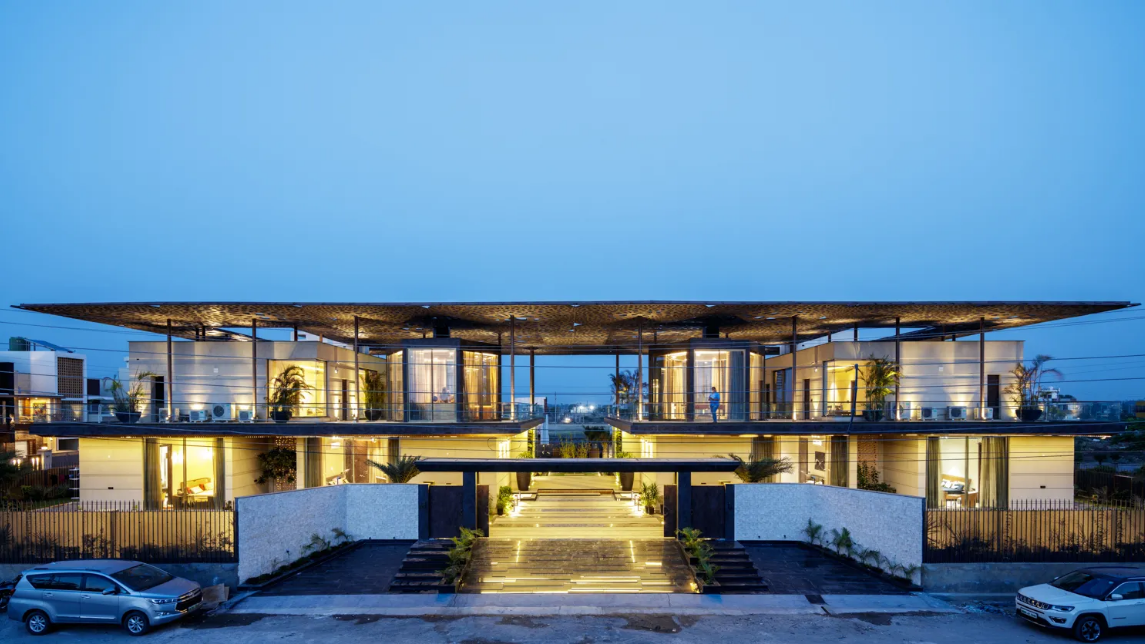
On the outskirts of Karnal, Haryana, a large home for a joint family has been designed as a small, self-supporting ecosystem. Conceived by the sustainability-focused Zero Energy Design (ZED) Lab, the project explored how to restore comfort to a barren plot in a way that stays gentle on the landscape and supports local biodiversity. Rastogi recalls that the site felt almost uninhabitable without shade—an insight that directly shaped the project’s defining move: a generous canopy that makes outdoor movement comfortable throughout the day.
The property is organized as two separate homes—one for each brother—mirrored in plan to maintain balance and privacy, while still meeting at a shared entry and a dramatic double-height connector space.
To unify both wings, the design uses consistent timber ceilings crafted from a locally sourced, fast-renewing species, along with entry surfaces clad in dark, leather-like Gwalior mint stone. The approach blends time-tested principles with contemporary expression and materials reinterpreted through a modern Indian lens.
The digitally modelled canopy—made from fibre-reinforced polymer over a mild-steel framework—creates a rainforest-like effect as sunlight filters and shifts across the ground. Beyond its visual drama, it extends usability: outdoor areas, including the pool, remain accessible even in peak summer. Shadow patterns evolve through the day, giving familiar spaces a changing character, and at night the darker tones recede into the sky.
Inside, the timber roof softens solar heat, while thick stone-clad walls, double-glazed windows, and carefully positioned openings reduce thermal load and improve cooling efficiency. The family added diverse trees around the home, placed for shade and fragrance—bringing birds and more nature closer to daily life.
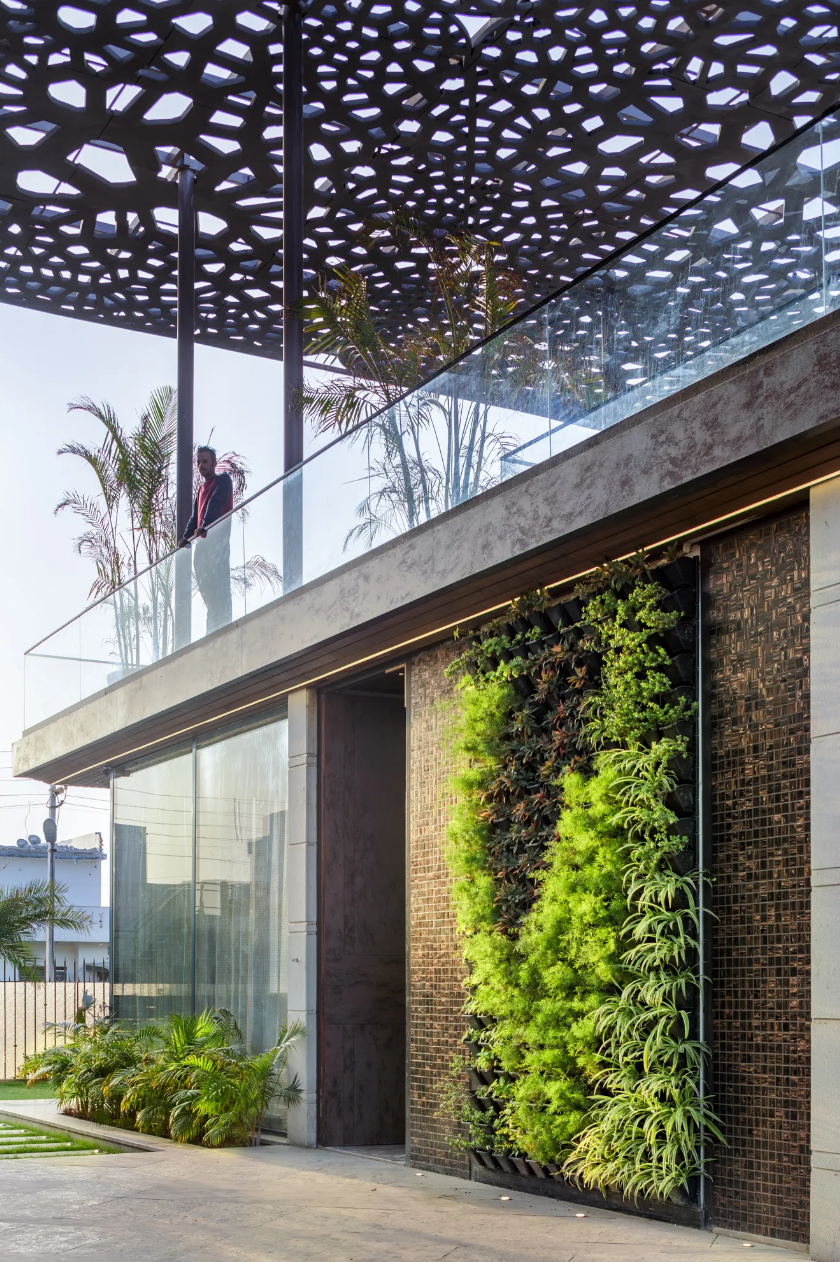
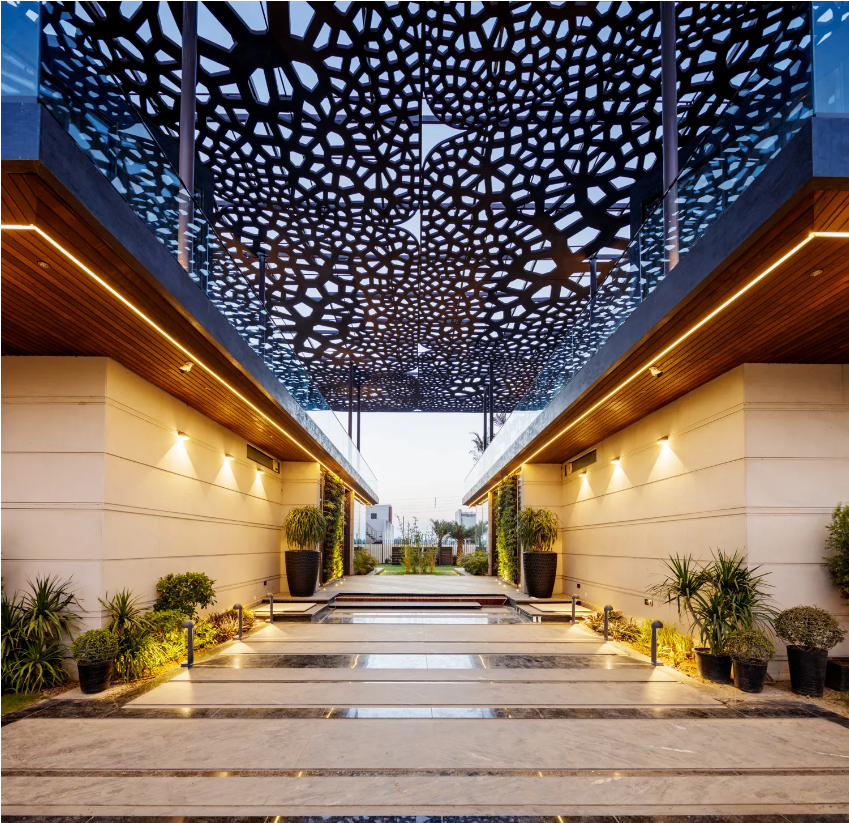
The entrance acts as a grand connector between the two wings. Finished in cooling Gwalior mint stone, it’s animated by softened light and shifting shadows, keeping it comfortable across the day. Oversized doors—about 13 feet tall and 5 feet wide—sit alongside a mild-steel framed partition that also functions as a vertical garden. A Laminam surface with a weathered-iron texture adds a grounded, rustic note to the home’s clean contemporary scale.
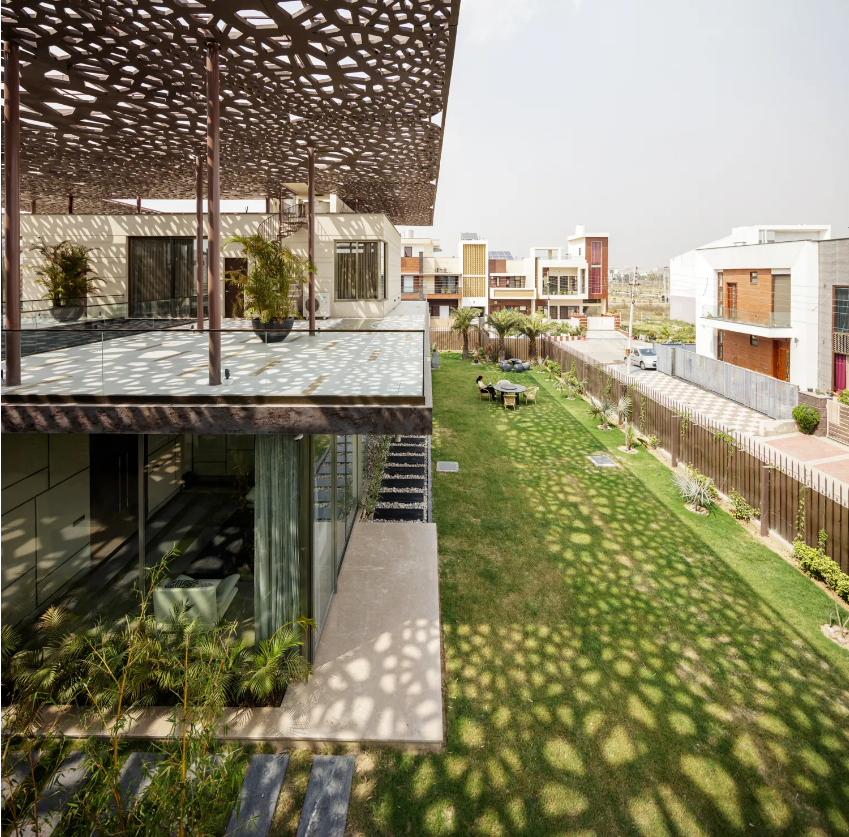
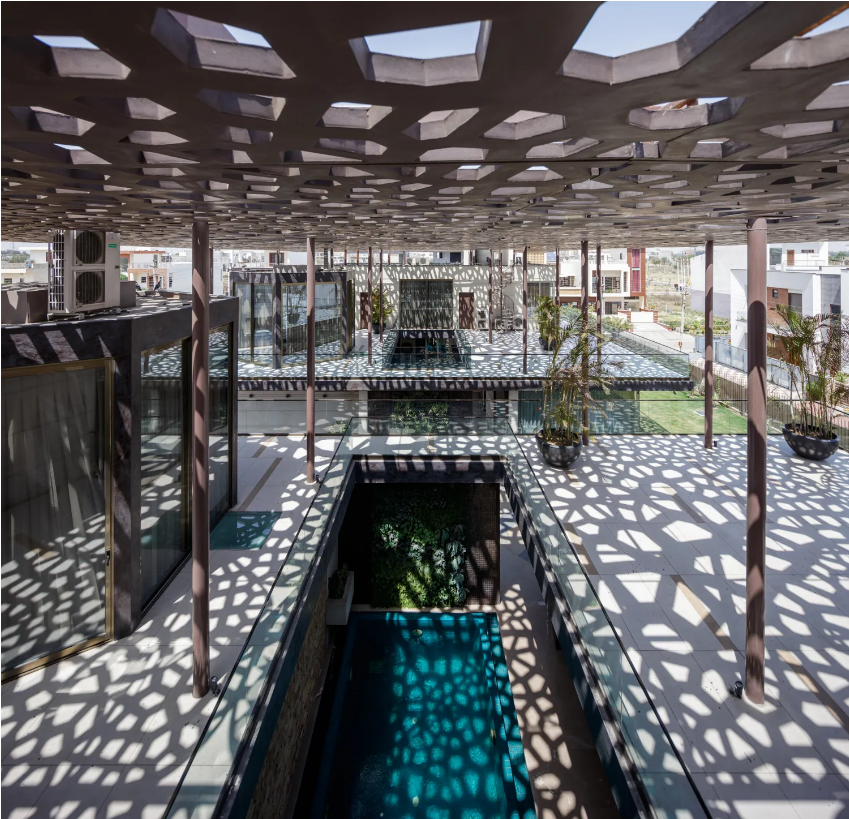
The structure of House Under Shadows was inspired by a neighbouring hotel called Noor Mahal, which was developed along the lines of a haveli. “Traditional havelis were developed with a standard layout: You have a public street outside, and then you have a courtyard which is an internal [open] space, surrounded by a deep veranda all around, which encourages socializing.” The courtyards in both houses have been fitted with an infinity pool, which serves the additional function of cooling the air and thereby creating a favourable micro-climate within the property. “It also lights up beautifully, and the diffused reflection of the sunlight creates a beautiful ambience,” explains Rastogi, “The sound of the water following down, the edge of the pool, and the view of the greenery beyond has a very soothing impact on the entire home.”
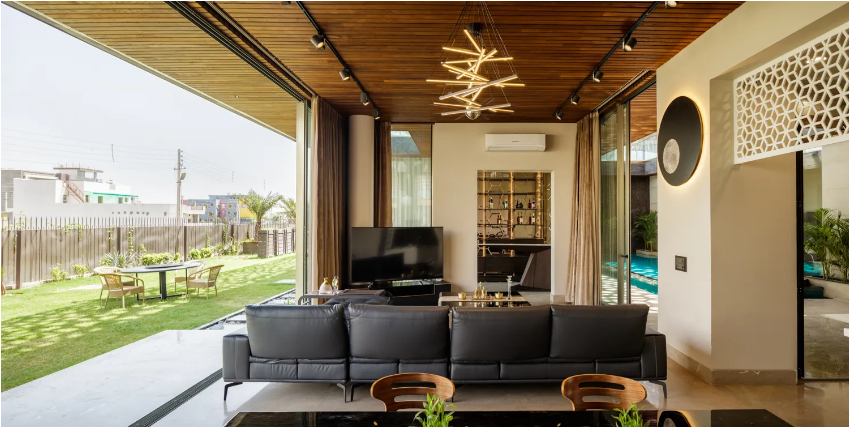
The living areas in both houses are set towards the northeast, while the sleeping areas are kept at the southwest; this reduces the thermal mass in the bedrooms and allows them to feel more cosy, while the living areas are kept open, and “blur the boundary between inside and outside”, as Rastogi puts it. “It is almost like living in a veranda throughout the day.” The ground-floor living rooms and lounges open towards the garden on the northeast, with glass partitions that offer a sense of visual continuity between the two environments. In between the lounge and living room is a bar, which serves as a small transitional space between the two public areas of the home.
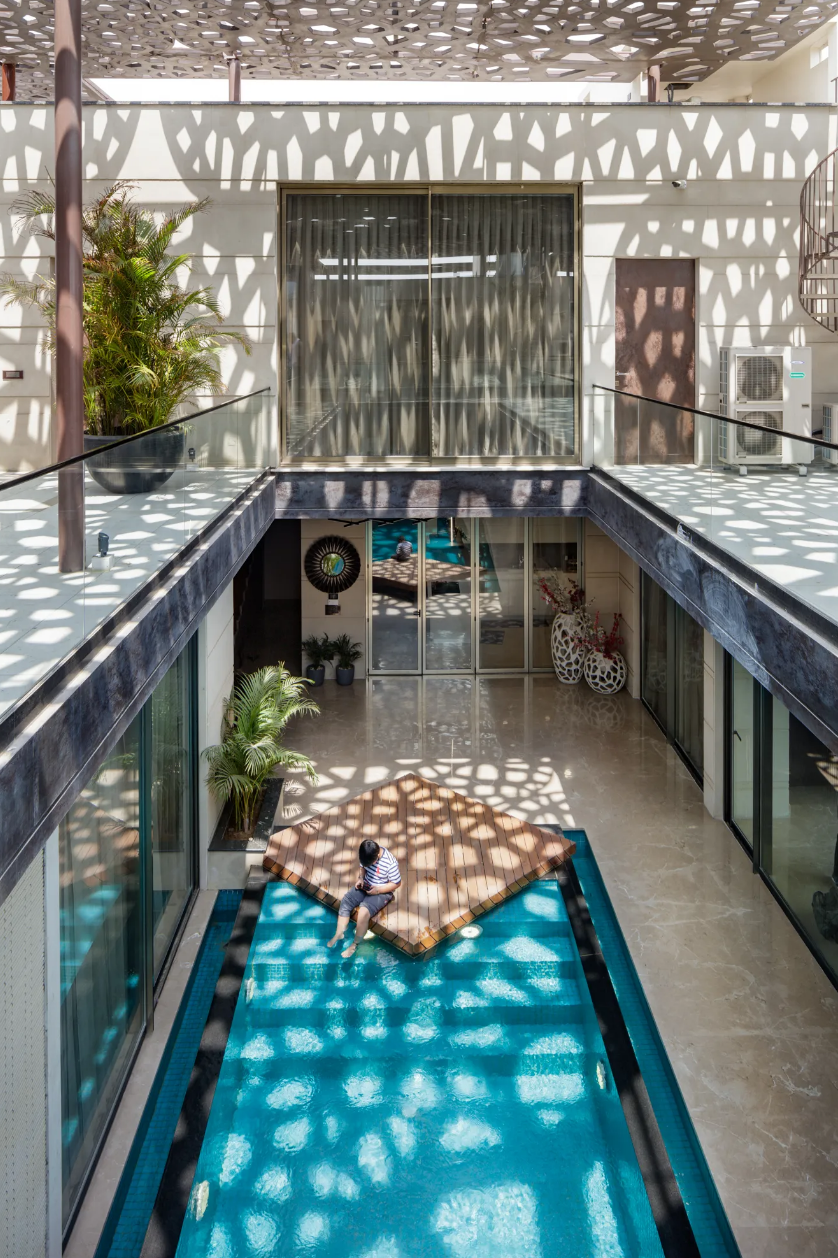
The ground floor has two bedrooms—a main bedroom and a children’s room—each of which has an en-suite bathroom and dresser. The two rooms are separated by a semi-open courtyard, which is a natural extension of the central courtyard. The main bedroom has its own private garden on one side, and a veranda overlooking the courtyard on the other—so the clients have a range of outdoor spaces they can enjoy, depending on the climate and temperature. “The courtyard is so close to the bedroom that you can open your window from the bedroom and put your legs into the water,” says Rastogi.
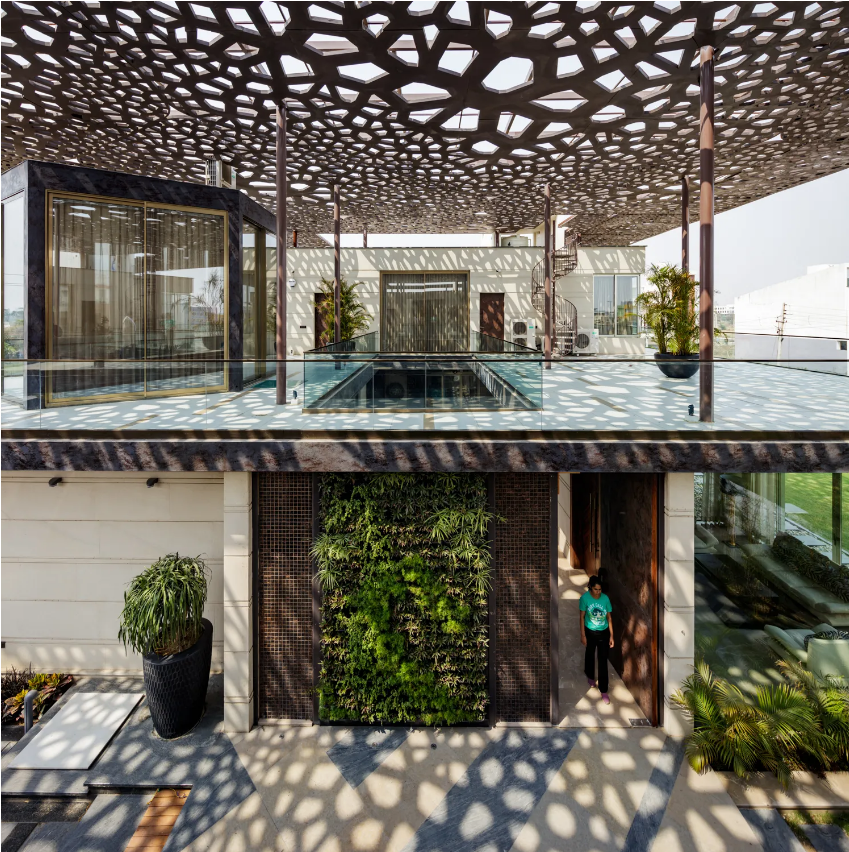
On the upper level is a multipurpose entertainment hall, inspired by the traditional chhatri of Noor Mahal. “These are very elaborate domed spaces where artists would sit and perform,” explains Rastogi, “We didn’t replicate the dome, but we used the same idea, and created this enclosed hexagonal glass box that allows you panoramic garden views.” In the evenings, the hall is open to the elements, which creates an almost ethereal ambience.
 Home
Home